In this guide
- What Is a Stud Dog?
- Where to Find a Stud Dog
- How to Choose the Right Stud Dog for Your Female
- Questions to Ask a Stud Dog Owner Before Breeding
- How Much Does a Dog Stud Service Cost?
- What Should a Stud Dog Contract Include?
- Red Flags to Watch for When Choosing a Stud
- Should You Use an Online Stud Dog Finder?
- How Petsfindly Can Help You Explore Suitable Matches
- Frequently Asked Questions
- The Right Stud Is Worth the Wait
You know your girl better than anyone. You know how she leans into strangers, how she settles at night, how she looks at you when the leash comes out. So when you start looking for a male to breed her with, scrolling through photos of handsome dogs feels strangely inadequate.
A picture can tell you his coat color. It cannot tell you whether he carries the same hidden health risk she does. Finding a stud dog of the right breed is easy. Finding one who is healthy, well tested, good-tempered and genuinely right for her takes a plan, and this guide gives you one.
Key takeaways
People before profiles
Her breeder, your breed club and your vet are the best first leads. Online listings come after.
Test both dogs
Brucellosis has no guaranteed cure and can spread to people. Both dogs need a current negative result.
Papers are not proof
Registration proves identity and parentage. Health results on OFA prove health.
Put it in writing
Fee, repeat mating, health documents and registration paperwork all belong in a signed agreement.
What Is a Stud Dog?
A male chosen to sire a litter, and a decision that shapes the puppies' health
A dog stud, or stud dog, is an intact male used to sire a litter, usually with a female owned by someone else. The arrangement is called stud service: the female's owner pays a fee, gives up a puppy, or both, in exchange for the breeding.
According to the American Kennel Club, the female's owner usually makes the final mating decision. That puts the choice, and the responsibility, in your hands.
Where to Find a Stud Dog
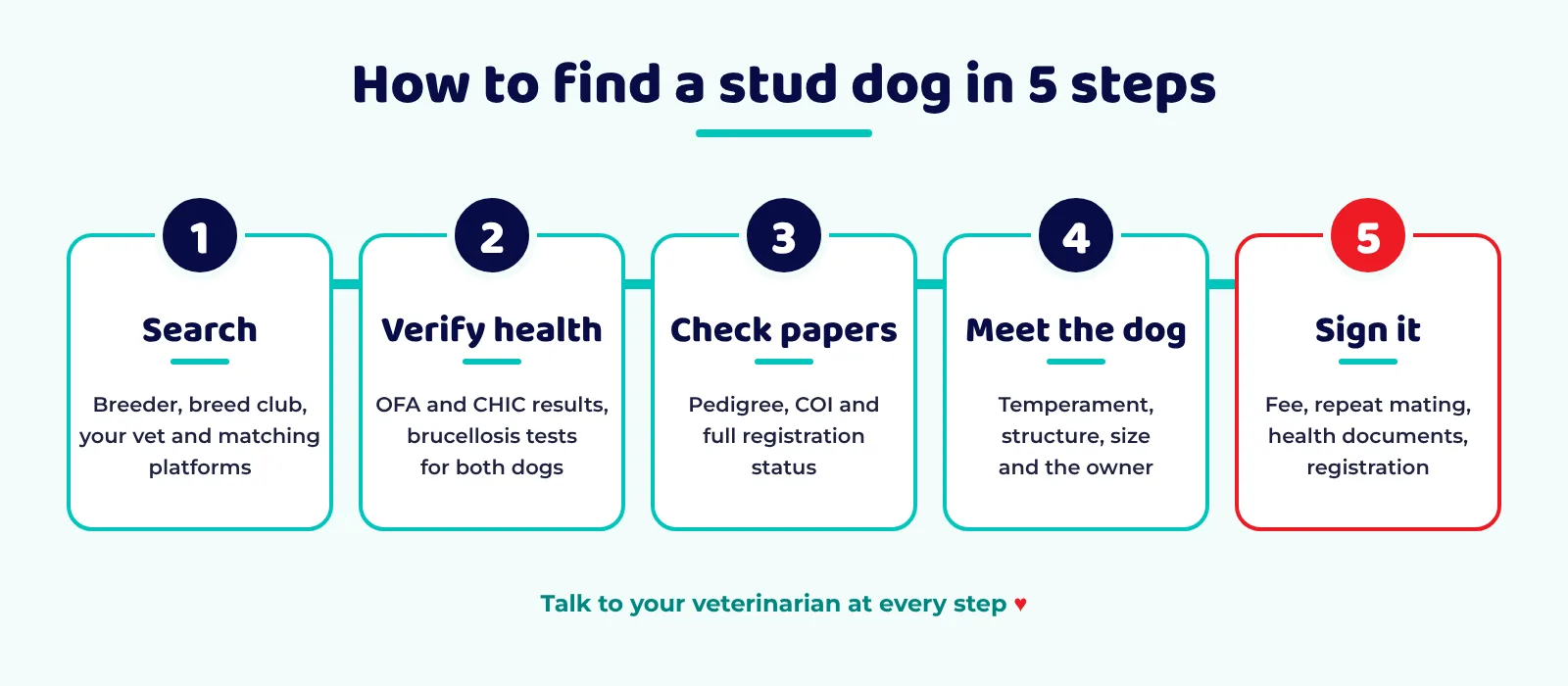
The best leads come from people who know your breed
Your female's breeder
Start here. Her breeder knows her pedigree, knows which lines pair well with it, and often knows which stud dogs have produced healthy, stable puppies. A responsible breeder may also want a say in where her line goes next.
Breed clubs and breed networks
Your breed's parent club sets the recommended health screenings for the breed, and members can often point you toward experienced owners with males worth considering. Some clubs also run directories. The Pembroke Welsh Corgi Club of America, for example, has an online stud dog search for members who may offer a stud. Dog shows and club events let you see males in person and watch how they cope with a busy environment.
Veterinary referrals
Your veterinarian, especially one who works with breeding dogs, may know local owners who offer dog stud services and take health testing seriously. A referral is a starting point, not a guarantee. You still run every check below.
Online stud directories and matching platforms
Online, you can search dogs for stud far beyond your local circle. That reach is useful, but a listing only tells you that a dog exists. It does not prove his health, his pedigree or his owner's honesty.
The Kennel Club also advises caution with a male who has already sired a very large number of litters, because heavy use of one popular dog can spread hidden inherited problems through a breed.
If you are ready to start a shortlist, you can browse stud dogs on Petsfindly by breed and town. Treat each profile as a lead, then use the checks in the next section before you agree to anything.
How to Choose the Right Stud Dog for Your Female
Looks are the last box to tick, not the first
Breed compatibility, temperament and size
Matching breeds is not the same as matching dogs. The AKC describes a stud worth considering as one with "all his health clearances," sound temperament and conformation, and the ability to complement the female rather than simply match her. If she has a structural weakness or a nervous streak, look for a male who is strong where she is not.
Meet him in person if you can. Watch how he greets strangers and handles a sudden noise. The Kennel Club advises avoiding males who are shy, nervous, unpredictable or aggressive, and steering clear of extreme features that can affect health, such as a very flat face or excessive skin folds. If the two dogs differ noticeably in size, ask your veterinarian whether that raises any concerns for mating or whelping.
Health testing and breed-specific genetic screening
This is where a careful search earns its keep. The Orthopedic Foundation for Animals (OFA) records health screening results such as hips, elbows, eyes and breed-specific DNA tests, and it runs the Canine Health Information Center (CHIC) with breed parent clubs. According to the AKC, a CHIC number "simply means that the dog has had all the health testing required for that breed." It does not mean every result was perfect, so read the individual results.
What to check, and where to check it
What to check | Where to verify it | Why it matters |
|---|---|---|
Breed-specific health screenings | OFA website, searched by the dog's registered name | Shows the actual results, not just a claim that tests were done |
CHIC number | OFA and CHIC database | Confirms he completed the tests his breed club requires |
Canine brucellosis | A recent lab result from his veterinarian | Protects both dogs, the litter and the people handling them |
Registration status | His registration certificate | Limited Registration means the litter cannot be registered |
Coefficient of inbreeding (COI) | A multi-generation pedigree for the planned pairing | Shows how closely related the two dogs are |
Health clearances and registration documents
Papers prove identity and parentage. They do not prove health. Ask for the dog's registration certificate and check his status. Under AKC Limited Registration, "no litters produced by that dog are eligible for registration," and only the dog's breeder (the litter owner) can change that. If you plan to register the puppies, confirm full registration before you sign anything.
Pedigree, breeding history and what "proven stud" really means
Ask for a multi-generation pedigree and calculate the COI for the planned litter. The Institute of Canine Biology explains that harmful effects begin to show at a COI of about 5 percent and become significant at around 10 percent. A first-cousin mating gives 6.25 percent, and a COI calculated over only a few generations will look lower than it really is.
A proven stud is a male who has already sired a litter. That is useful, but it has limits. It shows he was fertile at the time. It does not guarantee he is fertile now, and it says nothing about the health of the puppies he produced. The MSD Veterinary Manual notes that a recent fever can affect semen production for more than 60 days, which is why a current semen evaluation can matter more than an old success. Ask how his past puppies have turned out as adults.
Questions to Ask a Stud Dog Owner Before Breeding
A good owner welcomes every one of them
Go into the first conversation with a short list. These six cover the essentials:
1Health and genetic testing
What are his OFA results and breed-specific DNA results, and is he CHIC certified for the breed?
2Brucellosis
When was his last test, and can I see the result?
3Veterinary history and temperament
Has he had any recent illness, and how does he behave with strangers and other dogs?
4Previous litters
How many litters has he sired, and have any of his puppies developed health or temperament problems?
5Fee and payment
What is the fee, when is it due and what does it cover?
6Contract terms
What happens if she does not conceive, and is a repeat mating included?
Listen to how the owner answers, not just what they say. Specific answers backed by documents are a good sign. "Trust me, he's healthy" is not. For a fuller checklist, see Petsfindly's guide to questions to ask a stud dog owner before breeding.
How Much Does a Dog Stud Service Cost?
There is no single fair price, and anyone who quotes one is guessing
The price of a dog stud service is set by each owner, not by any national standard. It tends to reflect the breed, the male's pedigree and health credentials, his show or working record, local demand and the terms of the deal.
That is why searches for a golden retriever stud fee or a Cane Corso stud fee mostly lead to individual kennel pages, each with its own price and conditions. Without a reliable, current US source that averages stud fees by breed, this guide does not quote one. The same is true if you are looking at an English bulldog for stud service: ask each owner for their terms in writing and compare them side by side.
Common arrangements for stud services for dogs
Arrangement | How it works | What to clarify |
|---|---|---|
Flat fee | You pay an agreed amount for the breeding | When it is due and whether any part is refundable |
Pick of the litter | The stud owner takes a puppy instead of a fee | Which pick, and at what age they choose |
Fee plus puppy | A reduced fee plus a puppy | Both terms in full |
For a realistic range in your breed, ask your female's breeder or your breed club. Then budget beyond the fee itself: health tests, progesterone testing, travel or semen shipping, and veterinary care for her pregnancy all add up.
What Should a Stud Dog Contract Include?
Agree on everything while everyone is still friendly
A written agreement protects both owners and, most importantly, the puppies. The Kennel Club advises settling the details before mating and keeping a copy of the agreement. For any stud service for dogs, make sure it covers the points below.
Stud contract checklist
Clause | What to cover |
|---|---|
Fee and payment terms | The amount, the due date and whether a pick of the litter is involved |
Responsibilities of both owners | Who pays for tests, travel, boarding and veterinary costs |
Timing and mating arrangements | Where the mating takes place, how many matings are included, and natural mating or artificial insemination |
Health documentation | Current brucellosis results for both dogs and the male's health clearances, attached |
If mating is unsuccessful | What happens if she does not conceive or has a single puppy, and whether a repeat mating is offered and for how long |
Registration paperwork | What the stud owner will provide or sign so the litter can be registered |
The Kennel Club notes that two or three matings are often needed, so agree on that number upfront. If the best male lives far away, some owners offer chilled or frozen semen shipped to your vet. For AKC litters, chilled semen requires the sire to be AKC DNA certified, and frozen semen requires an AKC DNA profile for the sire and an insemination performed by a licensed veterinarian (AKC).
Red Flags to Watch for When Choosing a Stud
Walk away early; it costs far less than walking away late
Any one of these is reason enough to pause. A good match is worth waiting one more heat cycle for.
Should You Use an Online Stud Dog Finder?
Yes, to widen your search, never as a replacement for your own checks
A good stud dog finder saves time. Instead of waiting for word of mouth, you can filter by breed and distance and see which males are open to breeding. That is genuinely useful, especially in less common breeds.
What a finder cannot do is replace your judgment. A profile is only as accurate as the information its owner enters, and owner-shared health results still need checking against the original certificates and public databases. Use a finder to build your shortlist, then verify every dog on it the same way you would a referral from a friend.
How Petsfindly Can Help You Explore Suitable Matches
A wider shortlist, with the reasons behind every match
Petsfindly's dog mate finder lets you choose "I need a stud," pick a breed and town, and filter for listings marked as vaccinated, registered or DNA tested. Each suggested match explains why it was suggested, such as breed, distance and breeding age, so you can see how a match score works.
Frequently Asked Questions
Quick answers to common stud questions
How do I find a stud dog for my female?
Start with her breeder and your breed's parent club, then widen your search with a reputable matching platform. Shortlist only males whose health results you can verify, and meet the dog before you agree to anything.
What health tests should a stud dog have?
At minimum, a current negative brucellosis test and the screenings your breed's parent club recommends, which you can check through OFA and CHIC. Your veterinarian can tell you which tests matter most for your breed.
What is a typical stud fee for a golden retriever?
There is no reliable national average. Each owner sets their own stud fee for golden retriever males based on pedigree, health clearances and demand. Ask the Golden Retriever Club of America or local breeders for a realistic range, and get the terms in writing.
Is a proven stud always the better choice?
Not always. A proven stud has sired a litter before, but that does not guarantee current fertility or healthy puppies. An unproven male with complete health testing and a normal recent semen evaluation can be a sound choice.
Does my female need a brucellosis test too?
Yes. The AKC recommends testing both dogs before breeding, with females tested before each breeding.
Can a breeding guarantee puppies?
No. Even with healthy, well-matched dogs and good timing, pregnancy and litter size are never guaranteed. That is why the agreement should say what happens if she does not conceive.
The Right Stud Is Worth the Wait
Patience now protects her and her puppies later
Finding the right stud dog takes more than a good photo and a convenient location. It takes verified health results, honest conversations and a written agreement, all checked with your veterinarian.
Every step protects the same things: her health, and the puppies who will depend on the choice you make.
Ready when she is
Find a stud for your female on Petsfindly
Search by breed and town, see the reasons behind every match, and message owners without sharing your phone number. Then bring this guide with you and check every dog on your shortlist.
- Free to browse
- Phone-verified owners
- We never take payments
Sources
- American Kennel Club: Choosing a stud when breeding
- American Kennel Club: Health testing for a stronger breed
- American Kennel Club: Brucellosis testing for breeders
- American Kennel Club: Limited Registration
- American Kennel Club: Artificial insemination registration rules
- MSD Veterinary Manual: The breeding soundness examination
- Institute of Canine Biology: COI FAQs
- The Kennel Club: How to find and choose a mate for your dog
This guide is general information for dog owners and is not veterinary or legal advice. Talk to your veterinarian before making any breeding or health decision.