In this guide
- What Does It Mean to Stud Out Your Dog?
- Is Your Dog Ready to Be a Stud?
- How to Stud Out Your Dog in 7 Steps
- When Is the Best Time to Stud a Dog?
- Stud Fees: How Much Should You Charge?
- The Stud Contract: What to Put in Writing
- GSD, Yorkie and Golden Retriever Studs
- How to Become a Stud Owner People Trust
- Frequently Asked Questions
- The Bottom Line
Your dog has the kind of look that stops people on walks. Strangers ask about his breed, other owners ask about his parents, and sooner or later someone asks the big question: is he available for stud?
Before you say yes, it helps to know what you are signing up for. Learning how to stud out your dog responsibly involves much more than agreeing on a price. It means proving he is healthy, choosing the right females, putting every term in writing and being ready to stand behind the puppies he helps create.
This guide walks you through the whole process, from the first vet visit to the signed contract, with plain-English explanations of fees, timing and the paperwork that protects both owners. If you own the female instead, start with Petsfindly's dog breeding guide.
Key takeaways
Maturity first
Most owners wait until about two years old, the age at which OFA issues final hip and elbow ratings.
Health before hello
Brucellosis testing for both dogs is essential. There is no reliable cure and it can spread to people.
Put it in writing
A signed contract settles the fee, repeat breedings, puppies and paperwork before anyone travels.
Her cycle sets the date
Progesterone testing, not the calendar, tells both owners when to breed.
What Does It Mean to Stud Out Your Dog?
The basics, in plain English
When you stud out your dog, you offer your intact male as the sire for another owner's female, usually in exchange for a fee, a puppy from the litter, or both. The female's owner, often called the dam owner, takes on the pregnancy, the whelping and the puppies. You stay responsible for everything your dog brings to the pairing: his health, his genetics and his temperament.
That is why serious owners treat breeding stud dogs as a responsibility rather than a side income. One popular male can sire many litters over his lifetime, so a hidden health problem travels much further through a breed than it would from a single female. The upside is that every step that protects the breed also makes your dog more appealing to the careful, well-prepared owners you actually want to work with.
Is Your Dog Ready to Be a Stud?
Age, health and temperament come before any listing
Age and maturity
Male dogs can be fertile well before their first birthday, but fertile is not the same as ready. Most responsible owners wait until their dog is around two years old, and there is a practical reason for that. The Orthopedic Foundation for Animals (OFA) only issues final hip and elbow certification once a dog is at least 24 months old. Before then you only have preliminary results, and a female's owner has no reliable way to judge how his joints will hold up.
Waiting also lets his adult temperament settle. A dog who is calm and confident at two is a far safer bet than a one-year-old who is still working out the world. Petsfindly takes the same cautious view in its matching, which it explains in why breeding windows are strict on purpose.
Health clearances that matter
Every breed carries its own risks, so the right list of tests depends on your dog. Breed parent clubs publish recommended screenings, and many of them feed into the OFA's Canine Health Information Center (CHIC) database. Treat the table below as a starting point, then confirm the exact list with your veterinarian and your breed club.
Common health screenings for a stud dog
Screening | What it checks | Who usually needs it |
|---|---|---|
Canine brucellosis test | A contagious bacterial infection that causes infertility and pregnancy loss | Every stud of every breed. The AKC advises testing stud dogs at least once a year |
Hip evaluation (OFA or PennHIP) | Hip dysplasia and overall hip structure | Medium and large breeds such as German Shepherds and Golden Retrievers |
Elbow evaluation | Elbow dysplasia | Medium and large breeds |
Eye examination | Inherited eye disease, checked by a board-certified veterinary ophthalmologist | Most breeds, and often repeated yearly |
Patella (knee) evaluation | Kneecaps that slip out of place, known as patellar luxation | Toy and small breeds such as Yorkshire Terriers |
Cardiac evaluation | Inherited heart conditions | Many breeds, including Golden Retrievers |
Breed-specific DNA panel | Known genetic mutations, such as degenerative myelopathy | Breeds with DNA-testable inherited conditions |
Temperament and breed type
Health certificates show what is going on inside. Temperament and structure are what a female's owner notices first. A good stud is friendly with people, steady around other dogs and comfortable in new places, because those traits are partly inherited. He should also be a sound example of his breed standard. If you are unsure how he measures up, a breed club mentor, a conformation judge or an experienced breeder can give you an honest opinion before you invest in testing.
Interactive check
Is your dog stud-ready?
Tick everything that is true for your dog today. Nothing is saved or sent anywhere.
Let's see where he stands
Tick the boxes on the left to get your next step.
See the 7 stepsHow to Stud Out Your Dog in 7 Steps
From the first vet visit to the first litter
If you have been wondering how do I stud my dog out or how do you stud your dog out, this is the order most responsible owners follow. Most problems start when people jump ahead to the money conversation, so take the steps in sequence.
1Book a breeding soundness exam
Start with a full physical and a fertility check. Many owners ask a veterinarian who focuses on reproduction, known as a theriogenologist, to run a semen evaluation. It looks at sperm count, movement and shape, and it tells you whether your dog is likely to be fertile before you promise him to anyone.
2Complete his health testing
Work through the screenings recommended for his breed and keep the official certificates, not just a note from the clinic. Female owners will ask to see them, and many results can be looked up on the OFA website by the dog's registered name, which builds instant trust.
3Get the paperwork in order
If your dog is registered, keep his registration certificate, pedigree and microchip details in one place. With the American Kennel Club, the sire's owner signs the litter registration application, so your cooperation is part of every registered litter he produces. The AKC also requires a DNA profile once a dog becomes a Frequently Used Sire, meaning seven or more litters in his lifetime or more than three in a calendar year, and for any dog whose semen is collected for fresh-extended or frozen use.
4Build a stud profile that answers questions
Your listing is your first impression. Include clear, recent photos, his age, adult weight, registration, health results with certificate numbers, a few honest temperament notes and the terms you offer. Petsfindly's Stud My Dog page explains how a profile works, and you can list your stud for free so female owners see breed, age, distance and shared health tests before they send a message.
5Screen every female, and her owner
Saying yes to every inquiry is the quickest way to damage your dog's reputation. Ask for the female's age, health clearances, brucellosis result and registration. Ask how many litters she has had, when her last one was and where the puppies will go. A responsible dam owner will welcome the questions, and they will come prepared with plenty of their own. Petsfindly's guide to the questions to ask a stud dog owner before breeding shows exactly what a careful female owner is likely to ask you.
6Agree the terms and sign a contract
Before anyone travels, put the fee, payment timing, repeat breeding terms and puppy arrangements into a signed agreement. The contract section below lists every clause worth including.
7Time the breeding to the female's cycle
The female's body sets the schedule. Her vet uses progesterone blood tests to pinpoint ovulation, and the matings are planned around those results. Natural breeding is the most common approach. Artificial insemination is an option when distance, a size mismatch or nervous behavior makes a natural mating impractical, and it should always be performed or supervised by a vet.
Natural mating vs. artificial insemination (AI)
Method | How it works | Typically used when | Good to know |
|---|---|---|---|
Natural mating | The dogs mate naturally, usually at the stud's home | Both dogs are healthy, willing and well matched in size | Lowest added cost. The female normally travels to the stud |
Fresh AI | Semen is collected and inseminated right away | There is a size mismatch or one dog is inexperienced or anxious | Done on site by a vet |
Chilled AI | Semen is extended, cooled and shipped | The dogs live too far apart to meet | Needs tight timing with the courier. AKC requires a DNA profile for the stud |
Frozen AI | Semen is frozen and stored for later use | Distance, or preserving a valuable line for the future | Requires specialist vet work and usually has lower success rates than fresh semen |
When Is the Best Time to Stud a Dog?
Two timelines matter: his and hers
There are really two answers to when is the best time to stud a dog. The first is about your male's stage of life. Most owners begin once he is mature and fully health tested, usually around two years old, and continue for as long as he stays healthy, fertile and comfortable with the work. Many ask their vet to repeat his fertility check as he gets older.
The second answer is about the female's heat. Most females cycle roughly twice a year, although small breeds may cycle more often and giant breeds less. Only a few days in each cycle are truly fertile, and those days differ from dog to dog. That is why counting days on a calendar so often ends in a missed litter.
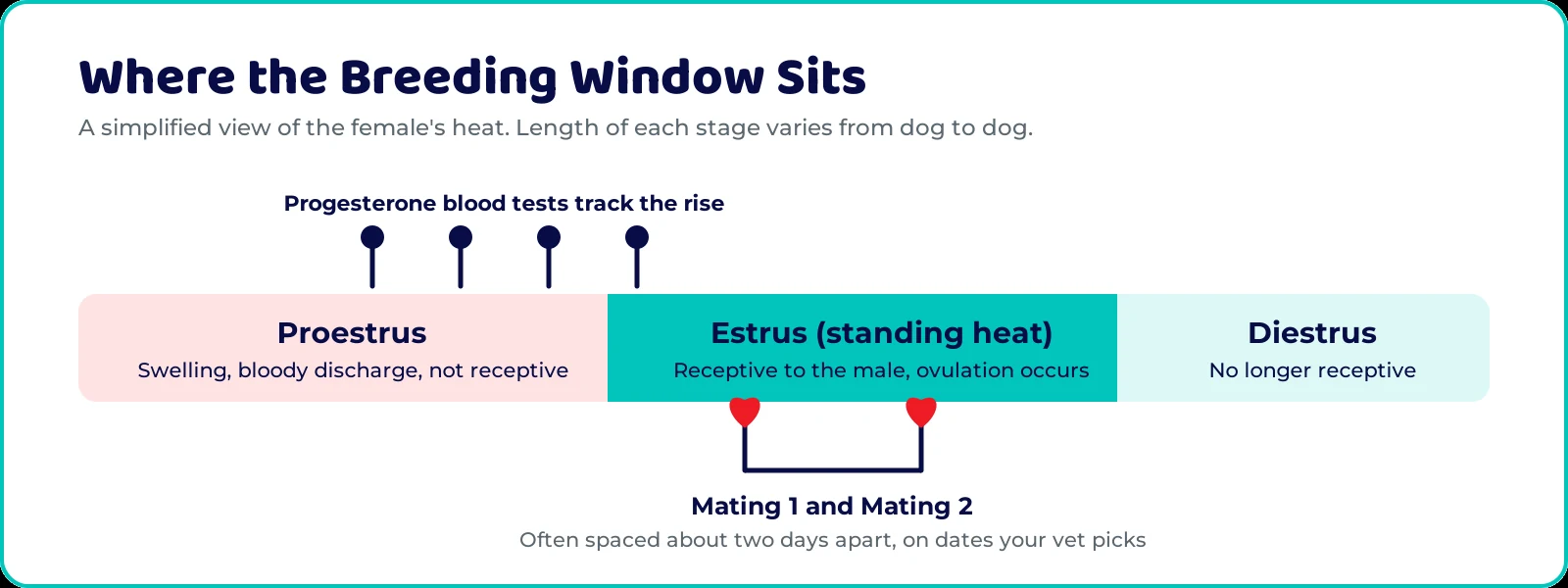
Progesterone testing takes the guesswork out. The female's vet runs blood tests every few days as her heat progresses and identifies when ovulation is happening. Matings are then planned for the days that follow, and many owners book two breedings roughly 48 hours apart to cover the fertile window.
Stud Fees: How Much Should You Charge?
Your price should reflect proof, not just good looks
There is no official price list for stud service. Fees across the US commonly run from a few hundred dollars to $3,000 or more, and where your dog lands depends on what you can document. A health-tested, titled male from a respected line with healthy litters on the ground can ask far more than an untested pet with no track record. Many breeders set their fee close to the price of one puppy from the expected litter.
Several things push a fee up or down: how in demand the breed is, how complete his health testing is, any conformation, working or performance titles, whether he is proven, the strength of his pedigree, and how many comparable studs are available nearby. Being honest about where your dog sits on each of these makes the fee conversation much easier.
Common stud fee structures
Fee structure | How it works | Works best when | Watch out for |
|---|---|---|---|
Flat fee | A set cash amount, paid at the mating or split between the mating and a confirmed pregnancy | You want a simple, clean arrangement | Spell out what happens if no puppies are born |
Pick of litter | You choose a puppy instead of cash, often when the litter is around eight weeks old | You want to keep or place a puppy from your dog's line | Define first or second pick, sex, and what happens with a very small litter |
Fee plus pick | A reduced cash fee plus a puppy | Both owners want a shared stake in the litter | More moving parts, so every detail must be in writing |
Beyond the fee itself, agree who covers the other costs. In most arrangements the female's owner pays for her travel, boarding, progesterone testing and any AI procedure, while the stud owner covers his own testing, care and upkeep. If your arrangement is different, write it down.
The Stud Contract: What to Put in Writing
A signed agreement protects both dogs and both owners
A handshake feels friendly right up until a litter has one puppy, or none. A written stud contract removes the guesswork and keeps the relationship on good terms. You do not need a lawyer to draft a basic agreement, although an attorney familiar with animal law in your state is worth consulting when the stakes are high.
Stud contract checklist
Clause | What to cover |
|---|---|
Owner and dog details | Names, addresses and phone numbers for both owners, plus both dogs' registered names, registration numbers and microchip numbers |
Health requirements | The screenings each dog must have, and a negative brucellosis result dated within an agreed period before mating |
Fee and payment | The cash amount, puppy terms or both, when payment is due and how it will be made |
Breeding method and attempts | Natural or AI, how many matings are included and where they will take place |
No pregnancy or small litter | Whether a repeat breeding on the next heat is included at no charge, and how many puppies count as a litter |
Puppy terms | Pick order, sex preference, the age at selection and who pays for the puppy's care until pickup |
Registration | Who completes the litter paperwork and when the stud owner will sign it |
Costs and liability | Travel, boarding, vet fees and responsibility if either dog is injured or falls ill |
Right to refuse | Either owner may cancel if a dog seems unwell or the female is not receptive on the day |
Disputes | How disagreements will be handled and which state's law applies |
GSD, Yorkie and Golden Retriever Studs
Popular breeds, specific priorities
GSD stud dogs
German Shepherds are among the most requested breeds, so competition among GSD stud dogs is real and female owners arrive well informed. Hip and elbow results sit at the top of almost every inquiry, because both forms of dysplasia are well known in the breed. Many owners also test for degenerative myelopathy, a progressive spinal disease with a known DNA marker. Working titles or temperament evaluations add weight for owners who want a sound working line. Browse current German Shepherd Dog profiles to see how other owners present their dogs.
Yorkie stud dogs
A Yorkshire Terrier stud needs a different checklist. Toy breeds are prone to patellar luxation, so a knee evaluation matters, along with an eye exam. Female owners may also ask about conditions seen in the breed such as Legg-Calvé-Perthes disease and liver shunts, so be ready to share what your vet has checked.
Size matters as well. Yorkie stud dogs should be well matched to the female, and many breeders avoid pairing a large male with a very small female to reduce the risk of a difficult delivery. If you plan to offer a Yorkie stud, list his adult weight clearly. You can see how Yorkies appear on the platform on the Yorkshire Terrier page.
Golden Retriever for stud
Owners searching for a Golden Retriever for stud usually expect a full set of clearances: hips, elbows, eyes and heart, in line with the screenings the breed's parent club recommends. Many also look for DNA results for inherited eye conditions. A Golden with complete, publicly listed results and a friendly, biddable temperament is exactly what careful dam owners hope to find. Explore Golden Retriever profiles on Petsfindly.
How to Become a Stud Owner People Trust
Proven, responsible and easy to work with
Plenty of owners search how to become a stud dog owner when what they really want is a dog other breeders seek out. Reputation is built slowly and lost quickly. When a female's owner starts looking for a stud for dog breeding in their area, they compare health results, past litters and how easy each owner is to deal with.
An unproven male has not sired a litter yet, so expect to charge less at first and to share his semen evaluation as reassurance. Once he has healthy litters on the ground, he becomes a proven stud, and that history is worth documenting. Keep simple records of every mating, litter size and any health issues reported by puppy owners. Limit how often he is used, decline pairings that are not a good fit, and stay in touch with the families raising his puppies. That kind of follow-through is what turns a good dog into a sought-after one.
Frequently Asked Questions
Quick answers to common stud questions
How do I stud out my dog if he is not registered?
You can, but your options shrink. Most female owners who plan to register their puppies need a registered sire, and without papers the puppies cannot be registered with the AKC. Health testing matters just as much either way.
How often can a stud dog breed?
A healthy, mature male can breed more often than a female, but heavy use can lower semen quality and spreads his genes very widely through the breed. Ask your vet for a sensible schedule and think about how many litters per year you are comfortable with.
Does the stud owner get paid if there are no puppies?
That depends on the contract. A common arrangement is that the fee covers the service, with a free repeat breeding on the female's next heat if she does not conceive. Some owners instead collect part or all of the fee once pregnancy is confirmed.
Do I need a lawyer to write a stud contract?
Not for a straightforward arrangement. A clear written agreement signed by both owners covers most situations. For high-value dogs or complicated puppy terms, an attorney who knows animal law in your state can review it.
At what age should a stud dog retire?
There is no single cutoff. Many males stay fertile for years, but fertility and semen quality tend to decline with age. Regular vet checks are the best guide to when it is time to stop.
How do I stud my dog out on Petsfindly?
Create a free profile, add his health tests and choose Breeding Partner. Female owners can see why your dog fits their search, and you can message without sharing your phone number. See how it works for the full walkthrough.
The Bottom Line
Responsible studs make better litters
Learning how to stud your dog the right way takes more time than simply quoting a fee, and that is the point. If you came here asking how to stud out my dog without costly mistakes, the answer comes down to patience and paperwork: wait until he is mature, prove he is healthy, choose females as carefully as their owners choose you, and put every term in writing.
Do that, and you protect your dog, the puppies he sires and the breed you love. You also earn the kind of reputation that brings the right owners to your door.
Ready when he is
List your stud free on Petsfindly
Build a profile that answers a female owner's questions before they ask. Every match shows why it fits, from breed and distance to the health tests you have shared, and your phone number stays private until you choose to share it.
- Free to browse
- Phone-verified owners
- We never take payments
Further reading
- American Kennel Club: Brucellosis, why dog breeders should not skip testing
- Cornell Riney Canine Health Center: Canine brucellosis
- Orthopedic Foundation for Animals: Frequently asked questions
- American Kennel Club: Frequently Used Sires requirement FAQs
This guide is general information for dog owners and is not veterinary or legal advice. Talk to your veterinarian before making any breeding or health decision.